
Every year, around the time Class 12 results come out, the same question floods student WhatsApp groups: “I got 84%. Am I eligible for the Central Sector Scholarship?”
The honest answer is: it depends. And the reason it depends is the part most blogs skip. CSSS does not ask for a fixed percentage. It asks whether you are in the top 20% of successful students in your own board and stream. That one detail decides who gets the scholarship and who gets rejected after spending weeks on paperwork.
In this guide, I will break down CSSS eligibility, the marks you actually need, the income limit, and the small mistakes that quietly cost students their application. If you are still comparing options, you can also read our full list of scholarships for Class 12 students in India.
CSSS Eligibility at a Glance
- Full name: Central Sector Scheme of Scholarship for College and University Students (CSSS), now shown on the portal under the PM-USP (Pradhan Mantri Uchchatar Shiksha Protsahan) branding
- Run by: Department of Higher Education, Ministry of Education, applied for through the National Scholarship Portal (NSP)
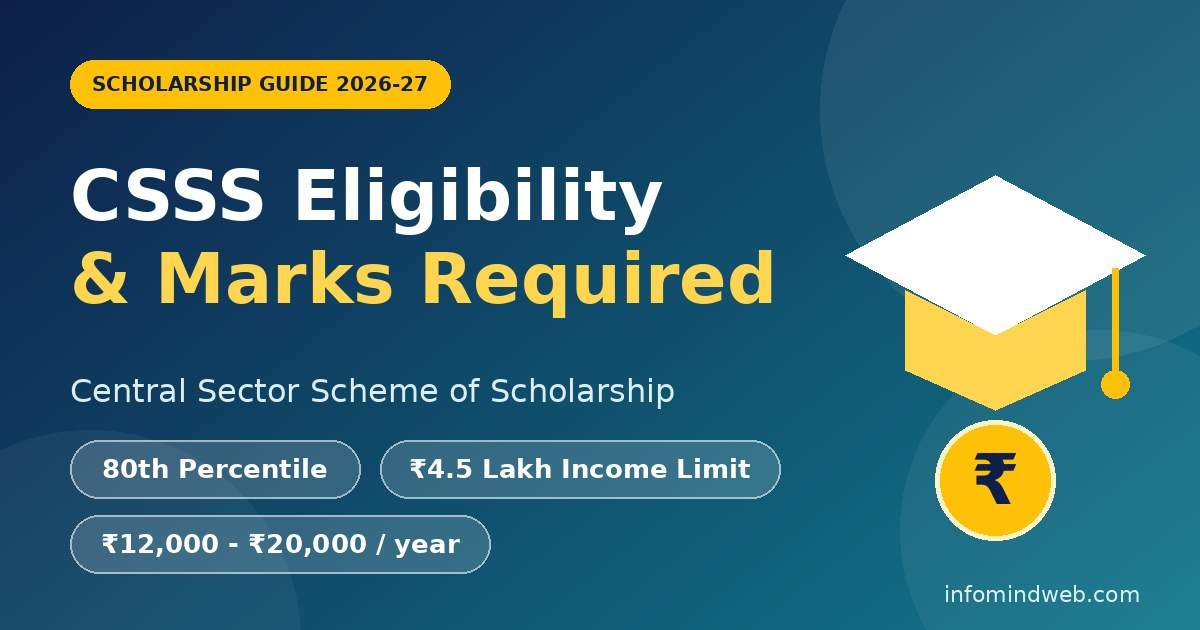
- Marks required: Above the 80th percentile of successful candidates in your Class 12 board and stream
- Family income limit: Up to ₹4.5 lakh per year
- Amount: ₹12,000 per year for the first three years of graduation, ₹20,000 per year at the postgraduate level
- Type: Merit-cum-means (you need both marks and a modest family income)
What Is the CSSS Scholarship?
CSSS is a merit-cum-means scholarship funded by the central government. It is meant for bright students from families that cannot easily afford college costs. Unlike category-based schemes for SC, ST, OBC or minority students, CSSS is open to students of every category, as long as the marks and income conditions are met.
That is why it is one of the most searched scholarships after Class 12. If you studied hard but your family’s budget is tight, this is one of the first schemes worth checking.
CSSS Eligibility Criteria (Fresh Applicants)
Here is the checklist I would run before touching the application form:
- You are an Indian citizen who has passed Class 12 (or an equivalent exam) from a recognised board.
- You are above the 80th percentile of successful candidates in your stream (Science, Commerce or Humanities) in your board.
- Your gross annual family income is ₹4.5 lakh or less.
- You are enrolled in a regular, full-time degree course at a recognised institution in India, undergraduate, postgraduate or professional.
- You are not receiving another central or state government scholarship, fee waiver or reimbursement for the same course.
Miss any one of these and the application will not go through.
CSSS Marks Required: 80th Percentile vs 80% Marks
This is the section that matters most, so let’s go slowly.
80th percentile does not mean 80% marks.
Percentile is about rank, not percentage. Being above the 80th percentile means you scored better than 80% of the students who passed in your board and stream.
A simple example (illustrative numbers)
Imagine 1,000 students pass the Class 12 Science exam in a board. To be above the 80th percentile, you must score higher than 800 of them, which puts you among the top 200 scorers. The marks that this works out to could be 88%, 91% or something else, depending on how that year’s results turned out.
This is why two students with the same 85% can have different outcomes. One may be above the cut-off in a board where marks are generally lower, and the other may fall short in a board where scoring is high.
Three things this means for you
- The cut-off changes every year. It depends on that year’s result distribution, so last year’s number is only a rough guide.
- It is board-wise. CBSE, ICSE and each state board have their own cut-off. You compete only within your own board’s pool.
- It is stream-wise. Science, Commerce and Humanities each have a separate cut-off. A common myth is that CSSS is only for Science toppers. It is not.
How to Check Your Board’s 80th Percentile Cut-Off
I am deliberately not printing a single “required marks” number here, because any fixed figure would mislead you. Instead, follow these steps:
- Visit the National Scholarship Portal (scholarships.gov.in) and open the CSSS section.
- Look for the board-wise and stream-wise cut-off list published by the Department of Higher Education after Class 12 results.
- Find your board, then your stream.
- Compare it with your total Class 12 marks (as the list specifies). If you are above the listed mark, you meet the merit condition.
If you cannot find the list, check the CSSS guidelines on the portal or ask your college scholarship cell to confirm.
CSSS Income Limit
The gross annual income of your parents or family must not exceed ₹4.5 lakh from all sources. You will need an income certificate issued by the competent authority in your state.
A quick tip: you may see some websites quoting a different figure. Always trust the current CSSS guidelines on NSP over a blog, including this one.
Who Is Not Eligible for CSSS?
This is where many students get surprised:
- Students who took a drop year after Class 12 are generally not eligible for a fresh application.
- Diploma students are not covered, since CSSS begins at the degree level after Class 12.
- Distance or correspondence education students are generally not eligible.
- Students already getting another central or state government scholarship for the same course.
- Students studying in an unrecognised institution.
CSSS Scholarship Amount
- Undergraduate (first three years): ₹12,000 per year
- Postgraduate level: ₹20,000 per year
It is not a huge amount, but for books, hostel costs or exam fees, it genuinely helps. If you are moving to a hostel, you might also like our guide on hostel life vs day scholar and the student budgeting ideas in student discounts and offers.
CSSS Renewal Eligibility
Getting the scholarship once is not the end. To continue every year, you must:
- Score at least 50% marks in your annual examination
- Maintain at least 75% attendance
- Remain in a regular course at a recognised institution
Students often lose renewal simply because attendance slips in the second year. Keep an eye on it.
Common Reasons CSSS Applications Get Rejected
- Confusing percentile with percentage. The most common mistake by far.
- Income above the limit or an income certificate that is outdated or from the wrong authority.
- Applying under the wrong board or stream details.
- Mismatched details between the marksheet, Aadhaar and bank account (name spelling, date of birth).
- Bank account not linked to Aadhaar or not in the student’s own name.
- Missing the deadline or leaving institute verification pending.
- Already receiving another scholarship for the same course.
Documents Usually Needed
The exact list is on NSP, but students typically keep these ready:
- Class 12 marksheet
- Aadhaar card
- Income certificate
- Bank passbook or account details (Aadhaar-linked)
- Proof of admission or bonafide certificate from your college
- Passport-size photograph
Scan them clearly before you start. Blurry uploads are an easy way to get stuck at verification.
Is CSSS Right for You? A 60-Second Self-Check
- Do I know my board and stream cut-off? Yes / No
- Is my total above it? Yes / No
- Is my family income ₹4.5 lakh or below? Yes / No
- Am I in a regular, full-time degree course? Yes / No
- Am I free from other government scholarships? Yes / No
Five yeses means you should apply. A single no means you should look at other options before wasting time.
CSSS Application Dates
The 2026-27 cycle opened on the NSP around June 2026. Different websites report the last date as either September 30 or October 31, 2026, so dates clearly vary by source and can be extended. Always confirm on scholarships.gov.in. If you missed this cycle, start preparing your documents early for the next one, because the window opens again each year.
Frequently Asked Questions
What is the marks required for CSSS? You need to be above the 80th percentile of successful candidates in your board and stream in Class 12. The actual marks differ every year.
Is 80% marks enough for CSSS? Not automatically. CSSS goes by percentile rank, not a flat 80%. Your marks may or may not clear the cut-off for your board and stream.
What is the income limit for CSSS? ₹4.5 lakh gross annual family income.
Is CSSS only for CBSE students? No. Students of ICSE and state boards can apply, and each board has its own cut-off.
Is CSSS only for Science students? No. Science, Commerce and Humanities students are all eligible, each with a separate cut-off.
Can I apply for CSSS after a gap year? Students who took a drop after Class 12 are generally not eligible for a fresh application.
Can diploma students apply for CSSS? No. The scheme is for regular degree courses.
Can I get CSSS and another scholarship together? Generally no, if the other is a central or state government scholarship or fee waiver for the same course.
How much money does CSSS give? ₹12,000 per year for the first three years of graduation and ₹20,000 per year at the postgraduate level.
What are the renewal conditions? 50% marks in the annual exam and 75% attendance.
Where do I apply for CSSS? Online, on the National Scholarship Portal (scholarships.gov.in).
Final Thoughts
CSSS is not hard to qualify for if you know the real rule. The whole scheme comes down to two numbers: above the 80th percentile in your board and stream, and family income up to ₹4.5 lakh. Check your board’s official cut-off first, keep your documents consistent, and apply early.
While you wait for the next cycle, strengthen your college journey with our 10 best study techniques backed by science and our explainer on APAAR ID, NEP 2020 and the four-year UG programme.
Disclaimer: Scholarship rules, amounts and dates can change. Always verify the latest details on the National Scholarship Portal before applying.