
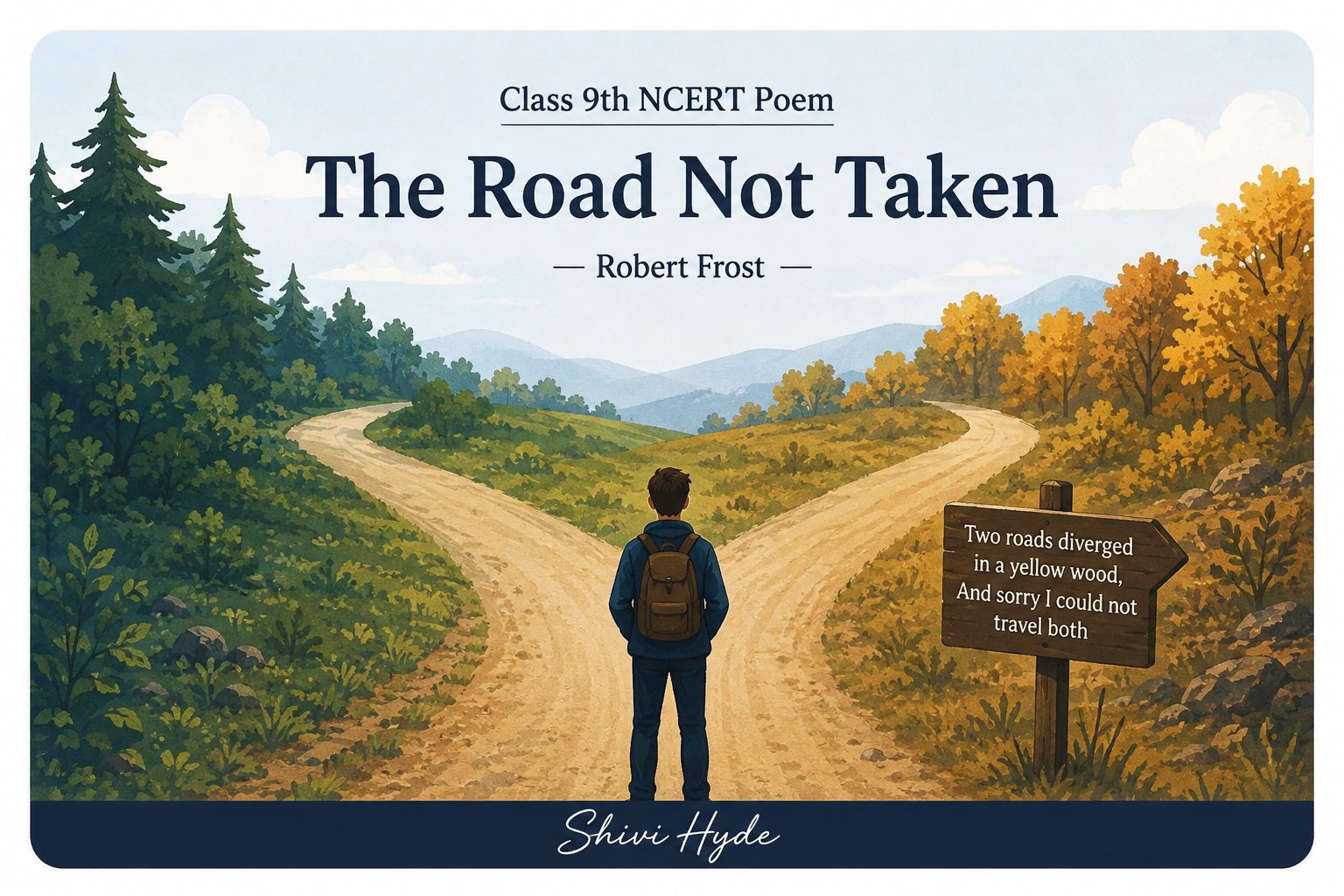
“The Road Not Taken” is one of the most quoted poems in English literature. It is also one of the most misunderstood. Many people read it as a cheerful poem about courage and individuality. A closer reading shows something more interesting: a poem about choice, regret and the stories we tell ourselves about our lives.
If you are a student looking for The Road Not Taken summary, stanza-wise explanation, themes and poetic devices, this guide covers everything in simple language. It is useful for school exams, especially for students who study the poem in Class 9 English.
About the Poet and the Poem
Robert Frost (1874–1963) was an American poet known for writing about rural New England life in plain language, with deeper meanings underneath. He won the Pulitzer Prize for Poetry four times. You can read more about his life in Britannica’s Robert Frost biography.
“The Road Not Taken” was published in 1916 in his collection Mountain Interval. The poem has four stanzas of five lines each, and it follows a steady rhyme scheme of ABAAB. You can read the full text on the Poetry Foundation.
A well-known detail behind the poem: Frost reportedly wrote it as a gentle joke about his friend, the poet Edward Thomas, who often regretted whichever path they chose on their walks in the English countryside. Keep this in mind, because it explains the poem’s quiet irony.
The Road Not Taken Summary (Short)
The speaker is walking in a forest in autumn when the path splits into two. He cannot walk both, so he has to choose. He stands for a long time, looks as far down one road as he can, and then picks the other. This second road looks grassy and less worn, though he admits that both are really about equally used.
He tells himself he will come back another day to try the first road, but he knows that one path leads on to another, and he is unlikely to return. The poem ends with the speaker imagining that many years from now he will tell this story with a sigh, saying that he took the road less traveled and that it made all the difference.
Stanza-wise Summary and Explanation
Stanza 1: The Choice Appears
The poem opens with the traveller standing at a fork in a yellow wood. He feels sorry that he cannot travel both roads and still remain one person. So he stops, studies one road as far as he can see, until it bends into the undergrowth.
Meaning: Every important decision begins with hesitation. The “two roads” stand for the choices we face in life, such as a career, a subject, a city or a relationship. The fact that he cannot take both shows a basic truth of life: choosing one option means giving up the other.
Stanza 2: The Second Road Seems Better
He then takes the other road, which seems just as fair and perhaps has a better claim because it is grassy and wants wear. But he immediately adds that passing travellers have worn both roads about the same.
Meaning: This is the key stanza for understanding the poem. The speaker first calls the second road less used, then admits there is hardly any difference. In other words, the choice was not as dramatic as he will later make it sound.
Stanza 3: No Difference, No Turning Back
On that morning, both roads lay covered in fresh leaves that no footsteps had blackened. He decides to save the first road for another day, yet he knows how way leads on to way and doubts he will ever come back.
Meaning: Life rarely gives us a second chance to return to the same crossroads. Each decision leads to new ones, and the earlier moment is gone. The word “doubted” shows that the speaker already understands this.
Stanza 4: The Story He Will Tell
In the last stanza, the speaker imagines himself somewhere “ages and ages hence,” telling the story with a sigh. He will say he took the road less traveled by, and that this has made all the difference.
Meaning: The sigh can suggest regret, relief, nostalgia or simply a person making a story out of the past. This ending is the reason the poem has so many interpretations.
Central Idea of The Road Not Taken
The central idea is that life is a series of choices, and we can never know how things would have turned out had we chosen differently. The poem also suggests that people tend to explain their past decisions in a more dramatic or meaningful way than the facts support.
Themes in The Road Not Taken
- Choice and decision-making: The whole poem revolves around one decision and how hard it is to make.
- Individuality: The popular reading is that the speaker bravely picks the unusual path.
- Regret and uncertainty: The sigh at the end hints that he may wonder what the other road would have offered.
- Irreversibility of time: Once a choice is made, we rarely return to the starting point.
- Self-storytelling: We create stories about our past, often making them neater than they really were.
Poetic Devices Used
- Metaphor: The two roads stand for life choices. This makes the poem an extended metaphor.
- Imagery: Phrases like “yellow wood” and leaves that “no step had trodden black” create a clear picture of an autumn forest.
- Symbolism: The yellow wood suggests autumn, a time of change and maturity in life.
- Alliteration: “Wanted wear” is one example.
- Rhyme scheme: ABAAB in each stanza.
- Repetition: The words “road” and “difference” return at key moments to stress the theme.
- Irony: The final claim about the “road less traveled” contradicts what the speaker said earlier.
Analysis: Is It Really About Courage?
Most people quote the last two lines as advice to follow your own path. That is a valid, inspiring reading. But look at the evidence in the poem itself. The speaker says both roads were “really about the same” and equally covered in leaves that morning. If the roads were nearly identical, the choice cannot truly have “made all the difference.”
So the more careful reading is this: the speaker will later describe his choice as bold and defining, even though it was not. The poem is less a celebration of non-conformity and more a gentle observation about human memory and how we shape our life stories.
For a student-friendly walkthrough with an additional perspective, you can also read this The Road Not Taken summary by Robert Frost on Vofeg. For a deeper literary breakdown of the poem’s language and tone, LitCharts and the Poetry Foundation article are reliable references.
Conclusion
“The Road Not Taken” works at two levels. On the surface, it is an encouraging poem about choosing your own path. Underneath, it is a thoughtful reflection on how we make decisions, live with them and later tell stories about them. That is exactly why it is still studied, debated and loved more than a century after it was written.
For exams, remember three things: the roads are a metaphor for life choices, the poem ends with a sigh that can be read in different ways, and the speaker himself admits the roads were nearly the same.
Exam Tips for Students
- Write the central idea first, in one or two lines.
- Explain each stanza in your own words, and mention the metaphor of the two roads.
- Point out at least three poetic devices with examples.
- Mention both readings of the ending (courage vs. irony) to score higher in analysis questions.
If you are preparing for other English chapters too, check out our guide on The Last Lesson Class 12 English: Summary, Characters, Themes & Question Answers. To make your revision more effective, read 10 Best Study Techniques Backed by Science. And if you are curious about the bigger picture of learning in India, our explainer on APAAR ID, NEP 2020 and the Four-Year UG Programme is worth a look. You can find more literature notes in the English category. For official school syllabus resources, visit the NCERT website.
FAQs on The Road Not Taken
1. Who wrote The Road Not Taken?
Robert Frost, the American poet, published it in 1916 in Mountain Interval.
2. What is the main message of The Road Not Taken?
Life is full of choices, we cannot take every path, and we often tell ourselves tidy stories about our decisions later.
3. What do the two roads symbolise?
They symbolise the different choices or opportunities a person faces in life.
4. What is the rhyme scheme of The Road Not Taken?
ABAAB in each of the four stanzas.
5. Why does the speaker sigh at the end?
The sigh can show regret, nostalgia, relief or the habit of romanticising the past. Frost leaves it open on purpose.
6. Did the speaker really take the less-travelled road?
He says so at the end, but earlier in the poem he admits both roads were worn about the same, which creates the poem’s irony.