
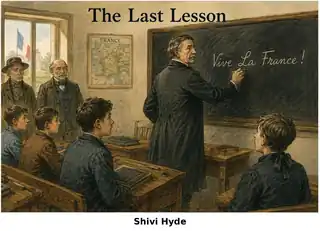
“The Last Lesson” is the first prose chapter in the CBSE Class 12 English textbook Flamingo. Written by the French author Alphonse Daudet, it is a short but emotional story about a boy, his teacher, and the day a language was taken away from a community. If you are looking for The Last Lesson summary, notes, character sketch, themes, and question answers in simple words, this guide covers everything in one place.
You can also read the original chapter in the official NCERT Flamingo textbook PDF. For another take on the summary, see this The Last Lesson summary for CBSE Class 12 English.
The Last Lesson at a Glance
| Detail | Information |
|---|---|
| Chapter name | The Last Lesson |
| Author | Alphonse Daudet |
| Book | Flamingo (Class 12 English Core, NCERT) |
| Genre | Short story (prose) |
| Setting | A village school in Alsace, France |
| Main characters | Franz (narrator), M. Hamel (teacher) |
| Central theme | Love for one’s mother tongue and freedom |
Background: Why Is This Story Set in Alsace?
To understand the story, you need a little history. After the Franco-Prussian War (1870–71), France lost the regions of Alsace and Lorraine to Prussia (modern Germany). The new rulers ordered that only German would be taught in schools there. French, the language of the people, could no longer be taught.
This order is the reason the lesson in the story is the last French lesson the students will ever receive from their teacher.
The Last Lesson Summary in Simple Words
The story is narrated by a schoolboy named Franz. On the morning of the story, he is very late for school and afraid of being scolded by his teacher, M. Hamel, because he has not prepared the lesson on participles. He is tempted to skip school and spend the day outdoors. The weather is beautiful, birds are chirping, and Prussian soldiers are drilling in an open field. But he resists the temptation and hurries to school.
On the way, he passes the town hall, where a crowd has gathered near the bulletin board. For the last two years, all bad news, such as lost battles and orders from the conquerors, had come from there. Franz wonders what new trouble it is now. The blacksmith, Wachter, who is standing there with his apprentice, tells him not to hurry, as he will reach school in plenty of time. Franz thinks he is making fun of him.
When Franz reaches school, he is surprised by the unusual calm. Normally, there is noise of desks opening and closing and lessons being repeated aloud. Today, it is as quiet as a Sunday morning. Through the window he sees his classmates in their places and M. Hamel walking up and down with his iron ruler. Franz has to open the door and enter in front of everyone, red-faced and frightened.
To his surprise, M. Hamel speaks to him kindly and asks him to take his seat. Franz then notices that the teacher is wearing his best green coat, a frilled shirt, and a little black silk cap with embroidery, clothes he wore only on inspection days and prize days. Even more surprising, the village elders, including old Hauser, the former mayor, and the former postmaster, are sitting quietly at the back of the room.
Then M. Hamel announces that an order has come from Berlin that only German will be taught in the schools of Alsace and Lorraine. This is his last lesson. The new teacher will arrive the next day.
These words shock Franz. He realises that the notice at the town hall was about this. He feels deep regret that he had wasted so much time and had hardly learned to write his own language properly. His books, which once felt like a burden, now feel like old friends he does not want to leave. Even M. Hamel, whom he used to fear, now seems different, and he forgets all about the ruler and the teacher’s bad temper.
When it is Franz’s turn to recite the rule of participles, he gets stuck at the very first word. M. Hamel does not scold him. Instead, he says that everyone is to blame. Parents did not care enough about their children’s education and preferred to send them to work in fields or mills to earn more money. And he himself had also failed at times: he had sent students to water his flowers instead of teaching, and given them a holiday whenever he wanted to go fishing.
M. Hamel then speaks about the French language. He calls it the most beautiful, clearest, and most logical language in the world, and tells his students to guard it among themselves and never forget it. He says that when a people are enslaved, as long as they hold on to their language, it is as if they have the key to their prison.
The lesson continues with grammar and then writing. Everyone writes with full concentration. Even old Hauser puts on his spectacles and reads the alphabet along with the little children, his voice trembling with emotion. Franz thinks it is so funny and sad at the same time that he wants both to laugh and cry. He also wonders whether the Prussians will now make even the pigeons coo in German.
At last, the church clock strikes twelve, and the Prussian soldiers’ trumpets sound outside the window. M. Hamel stands up, pale, and tries to say something, but his voice chokes. He takes a piece of chalk and writes in large letters on the blackboard: “Vive la France!” (Long live France!). Then he leans his head against the wall and, with a wave of his hand, dismisses the class: “School is dismissed. You may go.”
Character Sketch
Franz
Franz is a young, playful schoolboy who initially dislikes studying and prefers to play outdoors. He is honest and sensitive. The news of the last lesson changes him completely. He feels guilty for neglecting his mother tongue and becomes attentive for the first time. His transformation shows how we often realise the value of something only when we are about to lose it.
M. Hamel
M. Hamel is a dedicated, patient, and patriotic teacher who has taught in the same school for forty years. He is strict but caring. On the last day, he dresses formally to honour the occasion, takes responsibility for his own faults, and urges his students to love their language. His emotional breakdown at the end shows how deeply he loves his country and his profession.
The Village Elders
The presence of old Hauser and other villagers shows their regret for not having studied when they could. They come to thank the teacher for his forty years of service and to show respect for their country.
Themes of The Last Lesson
- Love for the mother tongue: Language is not just a means of communication. It is the heart of a community’s identity and culture.
- Language and freedom: M. Hamel’s line about the “key to the prison” shows that preserving one’s language keeps a people mentally free even under rule by others.
- Linguistic imperialism: The story shows how conquerors try to control a people by forcing their own language on them.
- Patriotism: The teacher’s final words, “Vive la France!”, express deep love for his nation.
- Regret and procrastination: Franz and the villagers regret putting off their education until it was too late.
- Respect for teachers and education: The students and elders gain a new respect for M. Hamel only when they are about to lose him.
Difficult Words and Meanings
| Word | Meaning |
|---|---|
| Participle | A word formed from a verb, used as an adjective or to form verb tenses |
| Bulletin-board | A notice board for public announcements |
| Reproach | To express disapproval or disappointment |
| Dismay | A feeling of shock and distress |
| Edict (order) | An official command |
| Enslaved | Made to lose freedom |
| Chalk | A soft stick used to write on a blackboard |
Important Question Answers
Q1. What was the order from Berlin? The order from Berlin said that only German would be taught in the schools of Alsace and Lorraine, so French could no longer be taught.
Q2. What was Franz asked to recite in school? Did he do it well? He was asked to recite the rule of participles. He could not do it well and got confused at the very first word.
Q3. What changes came over Franz when he heard of the order? He felt guilty about wasting time, his books felt like old friends, and he no longer feared M. Hamel. He now wanted to learn as much as possible.
Q4. What did M. Hamel say about the French language? He said it is the most beautiful, clearest, and most logical language in the world, and that people must guard it and never forget it.
Q5. Why did M. Hamel blame himself? He admitted he had often neglected teaching, by asking students to water his plants or giving holidays when he wanted to go fishing.
Q6. What does “Vive la France!” signify? It means “Long live France!” and expresses M. Hamel’s patriotism and his grief at losing his language and homeland’s identity.
Q7. Why did the villagers come to the last lesson? They came to thank M. Hamel for forty years of faithful service and to show respect for the country that was no longer theirs.
Value Points for Board Exams
- Mention the Franco-Prussian War and Alsace-Lorraine for context.
- Use the phrase “key to the prison” when writing about language and freedom.
- Show Franz’s transformation from careless to attentive.
- Highlight M. Hamel’s self-reflection and humility.
- Link the theme to modern issues like the loss of regional languages.
Frequently Asked Questions (FAQs)
Who wrote The Last Lesson? The story was written by the French author Alphonse Daudet.
Which chapter of Class 12 English is The Last Lesson? It is Chapter 1 of the prose section in Flamingo, the Class 12 English Core textbook of NCERT.
Is there a movie based on The Last Lesson? The Class 12 chapter is a short story, not a film. Students searching for a movie usually just want the story’s summary or a video explanation.
Is The Last Lesson in Class 10? No. In the CBSE syllabus, The Last Lesson is part of Class 12 English (Flamingo). Some students search for “Class 10” by mistake.
What is the main message of the story? The story teaches us to value our mother tongue, our education, and our freedom, and not to postpone learning until it is too late.
Conclusion
“The Last Lesson” reminds us that language is the soul of a culture and that we should never take our education or heritage for granted. Use this summary, character sketch, themes, and question answers as a quick revision guide for your CBSE Class 12 English exam. For more notes on English literature and other subjects, keep visiting InfoMind Web.