
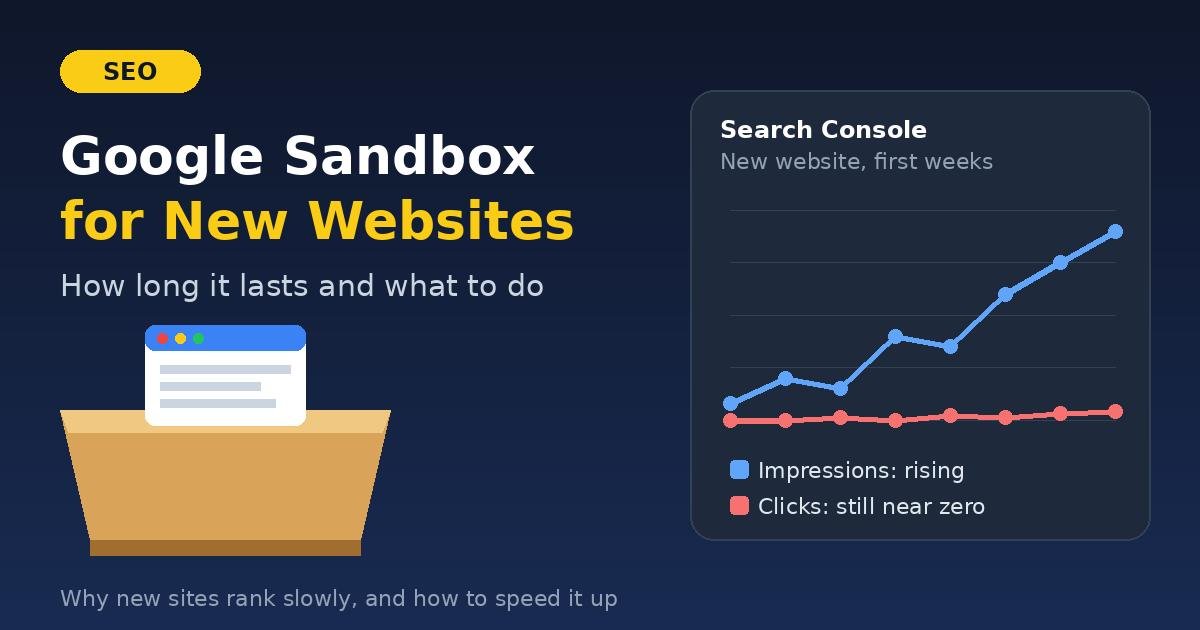
A few days after my new website went live, I opened Google Search Console and saw something that confused me: 138 impressions and 0 clicks in 24 hours. Google was clearly showing my pages to people. Nobody was clicking.
My first thought was, “Is my site stuck in the Google sandbox?”
If you are looking at a similar graph right now, this post is for you. I will explain what the Google sandbox is, whether it actually exists, how long new websites usually wait, and what you can do while you wait.
What Is the Google Sandbox?
The Google sandbox is a theory that Google holds new websites back from ranking well for a period, like a probation. The idea has floated around SEO circles since the early 2000s. Ahrefs describes it as an alleged filter that stops new sites from reaching top results, no matter how good the content is.
Is the Google Sandbox Real?
Officially, no. Google’s own people have repeatedly said there is no sandbox. Search Engine Journal’s coverage of John Mueller’s answers notes that Google has no fixed rule or timeline that blocks new pages from ranking.
But Google does not say new sites rank instantly either. In a Webmaster Hangout covered by Search Engine Journal, Mueller explained that brand new websites come with few signals, so Google has to make estimates about how they should rank.
So the honest answer is this: there may be no official sandbox, but new sites really do experience a slow start. The cause is a lack of trust signals, not a penalty. Mangools makes the same point: Google first needs time to understand what your site is about.
Why Does My New Website Get Impressions but No Clicks?
This is the question that sent me to Search Console in the first place.
Impressions mean your page appeared somewhere in the results. They do not mean it appeared on page one. A new site can show up on page 4 or 5 for dozens of queries. Google counts those as impressions, but almost nobody scrolls that far, so clicks stay at zero.
Other common reasons:
- Your average position is still too low to earn clicks
- Your title and description are vague or do not match the search
- You are targeting broad keywords where big, trusted sites dominate
- Google is still testing your pages for different queries, so impressions jump around
If you want to see which pages are moving and which are slipping, my guide on how to compare date ranges in Google Search Console to find declining pages walks through it step by step.
How Long Does the Google Sandbox Last?
There is no official number, because Google says the sandbox does not exist. Based on what SEO practitioners report, new sites commonly take anywhere from a few weeks to several months before rankings start to stabilize. Ahrefs gathered opinions from SEO professionals who see this sandbox-like pattern, and the range they describe is wide.
Google’s own SEO Starter Guide gives a useful reality check: changes can take anywhere from a few hours to several months to show in search, and you should wait a few weeks before judging whether your work helped.
My rule is simple. Do not judge a new site by 24 hours or even 7 days. Look at 28 days at a minimum, and compare against the previous period.
Signs Your New Site Is in the “Sandbox”
- Your pages are indexed, but rank on page 3 or lower for almost everything
- You get impressions but very few clicks
- Rankings rise for a few days, then drop back
- Your brand name ranks, but your topic keywords do not
If your pages are not indexed at all, that is a different problem, and it needs fixing before anything else.
What to Do While You Wait
Waiting does not mean doing nothing. Here is what I focus on.
1. Make sure Google can find and index your pages
Set up Search Console, submit your sitemap, and use the URL Inspection tool to request indexing for new posts. Google has a clear getting started guide for Search Console if you are new to it.
2. Target long-tail keywords, not broad ones
A search like “how to teach AI to kids” is crowded. A specific one like “AI activities for kids age 8 without a computer” is far easier to win. Small wins build trust faster than losing on big terms.
3. Fix your titles and meta descriptions
If you already have impressions, your title is the only thing standing between you and a click. Put the main keyword near the start, state a clear benefit, and keep the description honest and specific.
4. Publish fewer, stronger pages
Mueller has said he prefers fewer, stronger pages over many weak ones. A handful of genuinely helpful articles will do more than fifty thin ones.
5. Link your pages together
Use internal links with descriptive anchor text so Google understands how your content connects. Every new post should link to at least one older post and receive a link from one.
6. Build a few real signals
Share your posts where your readers are, answer questions in communities, and earn a few honest backlinks from relevant sites. Even a handful of genuine mentions helps a new domain look real.
7. Track progress properly
Every week, check impressions, clicks, CTR and average position. Watch the trend rather than the daily number.
What Not to Do
- Do not buy cheap backlinks or use link schemes. They can hurt a new site.
- Do not keep rewriting titles every few days. Give changes a few weeks.
- Do not copy or spin content to publish faster.
- Do not panic over daily drops. New sites fluctuate a lot.
My Takeaway
Seeing zero clicks on a brand new site feels discouraging, but it is normal. The impressions are actually a good sign: Google is already testing your pages. The work now is to give it reasons to rank you higher, with specific keywords, helpful content, clear titles and steady publishing.
Frequently Asked Questions
Is the Google sandbox real in 2026?
Google says there is no sandbox filter for new sites. However, new websites often rank slowly because Google has limited signals about them, so the effect feels similar.
How long does it take for a new website to rank on Google?
There is no fixed time. Many new sites see movement within a few weeks to a few months, depending on competition, content quality and indexing.
How do I get out of the Google sandbox?
Get your pages indexed, publish helpful content around specific long-tail keywords, improve titles and meta descriptions, build internal links, and earn a few genuine backlinks.
Why is my new website not showing in Google search results?
It may not be indexed yet, or it may be ranking too low to be seen. Check the URL Inspection tool in Search Console to confirm.
Why do I have impressions but no clicks?
Your pages are appearing in low positions, or your titles do not persuade searchers to click. Improving rankings and click appeal usually fixes this over time.
Can a new website rank in a week?
Sometimes a new page ranks briefly for very specific, low-competition queries, but lasting rankings usually take longer.