
I still remember my first notice writing question in an English paper. I knew the content perfectly well, a school fair was being organised, and I wrote a beautiful, detailed paragraph. I scored badly. Why? I forgot the heading, wrote it in the first person, and crossed the word limit by almost double.
If you are reading this, you are probably where I was: you know what to say but not how a notice is supposed to look. Good news: notice writing is one of the most predictable, scoring parts of the English writing section. Once you learn the format, it is basically free marks.
So let me guide you the way a senior would, with the format, real examples, and the mistakes I saw (and made) so you can skip them.
What Is a Notice? (Simple Definition)
A notice is a short, formal piece of writing used to give information to a group of people, such as students, residents, staff or members of a club. It is displayed on a notice board or shared publicly, so it is written to be read quickly.
If you want a dictionary-level definition, the Cambridge Dictionary entry for “notice” explains the word in its everyday sense. For exams, though, what matters is the format.
Why Notice Writing Matters in Exams
In CBSE’s English (Core) paper for senior classes, notice writing is part of the Writing Skills section and is typically limited to around 50 words. Marks and the exact pattern can change from year to year, so always check the latest curriculum and sample paper on the official CBSE Academic website. Many state boards also ask notices in Classes 8, 9 and 10.
The marking is usually split across three things:
- Format (heading, date, signature)
- Content (all the key details covered)
- Expression (clear, correct language)
The format alone often carries a good chunk of the marks. That is why it is the easiest place to lose marks carelessly and the easiest place to gain them.
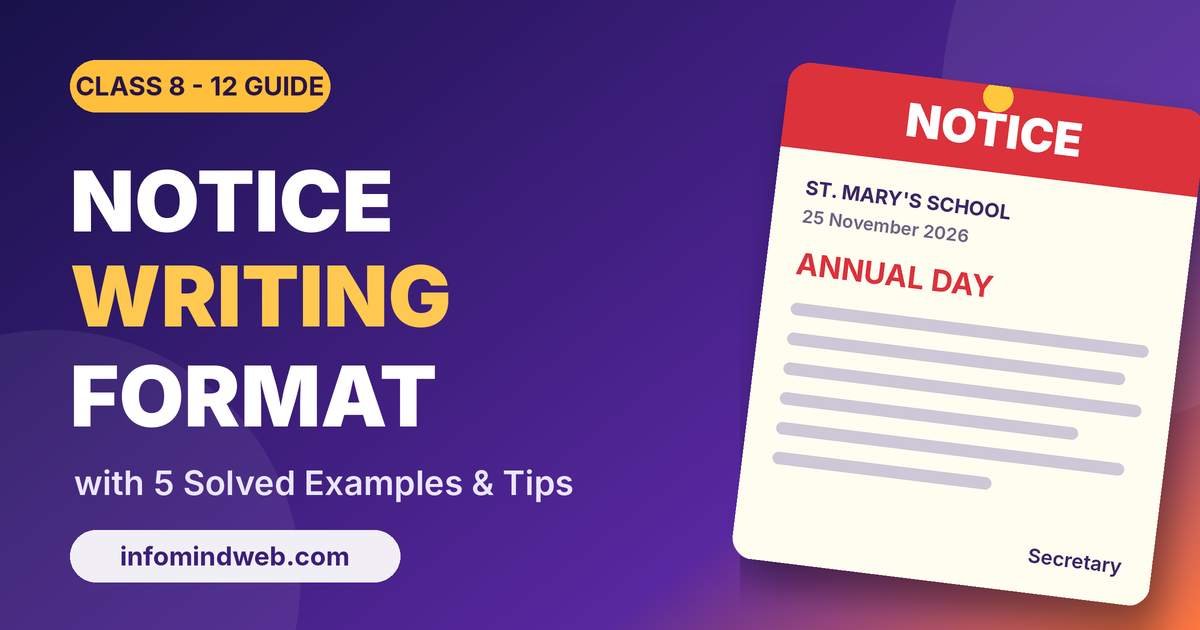
The Standard Notice Writing Format
Here is the structure to follow every single time:
- Name of the issuing body: School, college, society or organisation (at the top, centred)
- The word “NOTICE”: Centred, in capital letters, often boxed
- Date: Date of issuing the notice
- Heading or subject: A short title in capitals or bold (for example: ANNUAL SPORTS DAY)
- Body: What, when, where, who can participate, and any other detail (kept brief)
- Name and designation of the writer: Signed off as, for example, Ravi Kumar, Head Boy / Sports Secretary
A Quick Format Template
[NAME OF SCHOOL / ORGANISATION]
NOTICE
25 November 2026
[HEADING]
[Opening line stating the purpose] [Date, time and venue] [Who should attend or participate] [Any instruction, fee, last date or contact]
[Name] [Designation]
The 5 Golden Rules of Notice Writing
These are the rules I wish someone had told me in Class 11:
- Stay within the word limit. Usually 50 words. Count them. Don’t guess.
- Never use “I” or “we”. A notice is impersonal. Write “All students are informed that…” rather than “I want to tell you…”
- Cover the 5 Ws. What, When, Where, Who, and Why. If one is missing, you lose content marks.
- Use the passive voice where natural. “A debate competition will be held…” sounds right for a notice.
- Always add the issuer’s name and designation at the end. And do not use your own name. Use the name given in the question. If none is given, use the designation only (and mention the name only if the question gives it).
Notice Writing Examples (Solved)
The best way to learn is to see it done. Here are examples for the topics that come up again and again.
Example 1: School Event Notice (Annual Day)
ST. MARY’S SENIOR SECONDARY SCHOOL, LUCKNOW
NOTICE
20 December 2026
ANNUAL DAY CELEBRATION
All students are informed that the Annual Day will be celebrated on 10 January 2027 at 10 a.m. in the school auditorium. Students interested in dance, music or drama may give their names to the Cultural Secretary by 28 December 2026. Rehearsals will begin from 2 January after school hours. Parents are cordially invited.
Anita Sharma Cultural Secretary
(Word count: about 50)
Example 2: Lost and Found Notice
DELHI PUBLIC SCHOOL, GHAZIABAD
NOTICE
18 November 2026
LOST: BLUE WATER BOTTLE
A blue steel water bottle with the initials “R.K.” was lost near the school playground on 17 November 2026. Whoever finds it is requested to return it to the Class XII-B classroom or contact the undersigned. A suitable reward will be given.
Rohan Kapoor Class XII-B
This is a good example of how a lost and found notice keeps the description short but specific, with a clear place, date and contact point.
Example 3: Change in School Timings
GREEN VALLEY PUBLIC SCHOOL
NOTICE
1 December 2026
REVISED SCHOOL TIMINGS
All students and parents are informed that, owing to severe cold, school timings from 5 December 2026 will be 9 a.m. to 2 p.m. instead of 8 a.m. to 2:30 p.m. The revised timings will remain in force until further notice. Students are advised to come in proper winter uniform.
Principal
Example 4: Blood Donation Camp
NATIONAL YOUTH WELFARE SOCIETY
NOTICE
22 November 2026
BLOOD DONATION CAMP
A blood donation camp is being organised on 5 December 2026 from 9 a.m. to 3 p.m. at the community hall, Sector 12. Healthy individuals aged 18 to 60 years may donate blood. Refreshments will be provided. Interested members may register with the Secretary by 3 December.
Meena Joshi Secretary
Example 5: Hostel Notice
SARDAR PATEL BOYS’ HOSTEL
NOTICE
24 November 2026
MESS TIMINGS DURING EXAMS
All hostel residents are informed that during the examination period, from 1 to 15 December 2026, breakfast will be served from 6:30 a.m. to 8 a.m. Residents are requested to keep the mess clean and not to waste food. Lights-out time will be extended to 12 midnight.
Hostel Warden
If you live in a hostel, you already know how many notices appear on the board every week, so use that real-life knowledge. Practising with situations you have actually seen makes the writing natural. You may also like our guide on hostel life tips for students on infomindweb.com.
Notice Writing by Class: What to Expect
Notice Writing Format for Class 12
Class 12 students usually face a notice of about 50 words in the Writing Skills section. The topics are generally formal: school events, cancellations, competitions, awareness drives and so on. Precision and format are what the examiners look for. Always read the latest sample paper from the CBSE Academic website to confirm the marks and word limit.
Notice Writing Format for Class 11
The format is the same as Class 12. Practise a few of every type: event, lost and found, change of schedule, and appeal or request.
Notice Writing for Class 10 and Class 9
The CBSE writing section in these classes has changed over the years, so confirm the current pattern before you start practising. Many state boards still include notices, so if you are in a state board school, ask your teacher or check your board’s official syllabus. Even if notices are not asked, learning this format builds a strong base for formal letters and other writing tasks. You can also use NCERT’s official resources to revise grammar and writing skills.
Notice Writing for Class 8
For Class 8, the notice is usually shorter and simpler. Teachers focus on the heading, date, a clear message and your designation. Practise with simple school-based topics such as a library week, a picnic, or a lost item.
Types of Notices You Should Practise
- School or college event notices: annual day, sports day, science exhibition
- Lost and found notices
- Change in timing or schedule
- Cancellation or postponement notices
- Competition and workshop announcements
- Awareness and health drive notices: blood donation, cleanliness drive, vaccination
- Society or residential notices: water supply cut, maintenance, meetings
- Appeal or request notices: donation, volunteers needed
Common Mistakes Students Make (and How to Fix Them)
- Writing a letter instead of a notice. No “Dear Sir”, no “Yours faithfully”.
- Forgetting the date or heading. Easy marks, gone.
- Missing key details. Time, venue and contact are the usual casualties.
- Crossing the word limit. Cut every word that does not add information.
- Using your own name in the signature. Use the name or designation given in the question.
- Making it emotional or chatty. A notice is not a story. Keep it factual.
My Practical Tips to Score Full Marks
- Practise under a timer. Aim to finish a notice in 8 to 10 minutes.
- Make a mental checklist: heading, date, 5 Ws, designation. Tick it off every time.
- Read toppers’ answer sheets or sample papers and notice what they leave out. Good notices are tight.
- Revise vocabulary for notices: “is hereby informed”, “is requested to”, “will be held”, “last date”, “for further details”.
- Get one friend or senior to check your notice. A second pair of eyes catches missing details quickly.
Frequently Asked Questions (FAQs)
Q1. What is the correct format of notice writing? Name of the organisation, the word NOTICE, date, heading, body (what, when, where, who) and the name with designation of the writer.
Q2. What is the word limit for a notice? Typically 50 words for senior classes, but always confirm with the latest official sample paper from your board.
Q3. Do I need to write the date in a notice? Yes. The date of issue is part of the standard format.
Q4. Should I write my own name in the notice? Only if the question allows it. Usually you sign with the designation given, such as Head Boy, Secretary or Principal.
Q5. What is the difference between a notice and a letter? A notice is public and impersonal, written for a group, and has no salutation. A letter is addressed to a specific person and has a greeting and closing.
Q6. Can I use bullet points in a notice? Short lists are acceptable in some cases, but paragraphs in a compact form are safer for exams within the word limit.
Final Words
Notice writing is not about writing beautifully. It is about writing correctly, briefly and completely. Learn the format once, practise five to six notices, and you will walk into the exam hall with one section already in your pocket.
If this guide helped you, share it with a friend who is preparing for boards, and keep exploring more student-friendly guides on infomindweb.com.